FAQs
Why pay for this?
I can do this myself.
Fair point: If you’re using a top AI in a desktop browser, you can absolutely get useful feedback—especially on excerpts and specific scenes.
What you can do yourself (and do well):
- Get strong feedback on an excerpt: Voice, clarity, tone, and whether the opening hooks are all great use cases for pasted chapters.
- Ask for developmental-style notes: Structure, pacing, character, stakes—especially if you provide a rubric and follow up.
- Brainstorm fast: Loglines, taglines, back-cover summaries, comparable-title ideas, and alternative plot angles.
- Workshop scenes: Scene goal/conflict/outcome, tension mapping, confusion checks, and “what would make this hit harder?”
- Iterate conversationally: Challenge the feedback, ask for examples, and test multiple rewrites quickly.
What you can’t assume you’ll get (even with a top AI):
- Reliable whole-book awareness: Full manuscripts plus instructions plus comprehensive output can exceed context limits—or force chunking that loses arc-level understanding (setups/payoffs, reversals, long-running motifs).
- Consistency run-to-run: The same prompt can yield different frameworks and priorities. That makes it harder to compare drafts and track improvement.
- A true multi-pass editorial approach: Strong feedback usually requires multiple passes (structure → pacing → character → clarity → theme → market fit) and a final reconciliation. In a chat UI, you’re often the project manager keeping it coherent.
- Structured output that never drifts: Long responses can collapse formatting, skip sections, or wander into prose when you need predictable categories and completeness.
- Novel-scale character tracking: Aliases, nicknames, titles, transformations, mistaken identity, and timeline variants can create duplicates or omissions unless identity rules are applied consistently.
- Evidence-based critique anchored to the text: It’s easy to get plausible generalities. Harder is consistent “claim + where it appears + why it matters + what to change,” across the entire book.
- Long-form output reliability: Big responses can truncate, partially generate, or lose coherence across message boundaries when you’re aiming for comprehensive coverage.
- Repeatable draft comparisons: To see improvement, you want the same criteria applied the same way, with deltas called out—not a totally new rubric each run.
Bottom line: a top AI can help. The gap is getting a whole-book, repeatable, integrated process that stays consistent across long manuscripts and across drafts.
QR4AI (AI Transparency)
What is QR4AI?
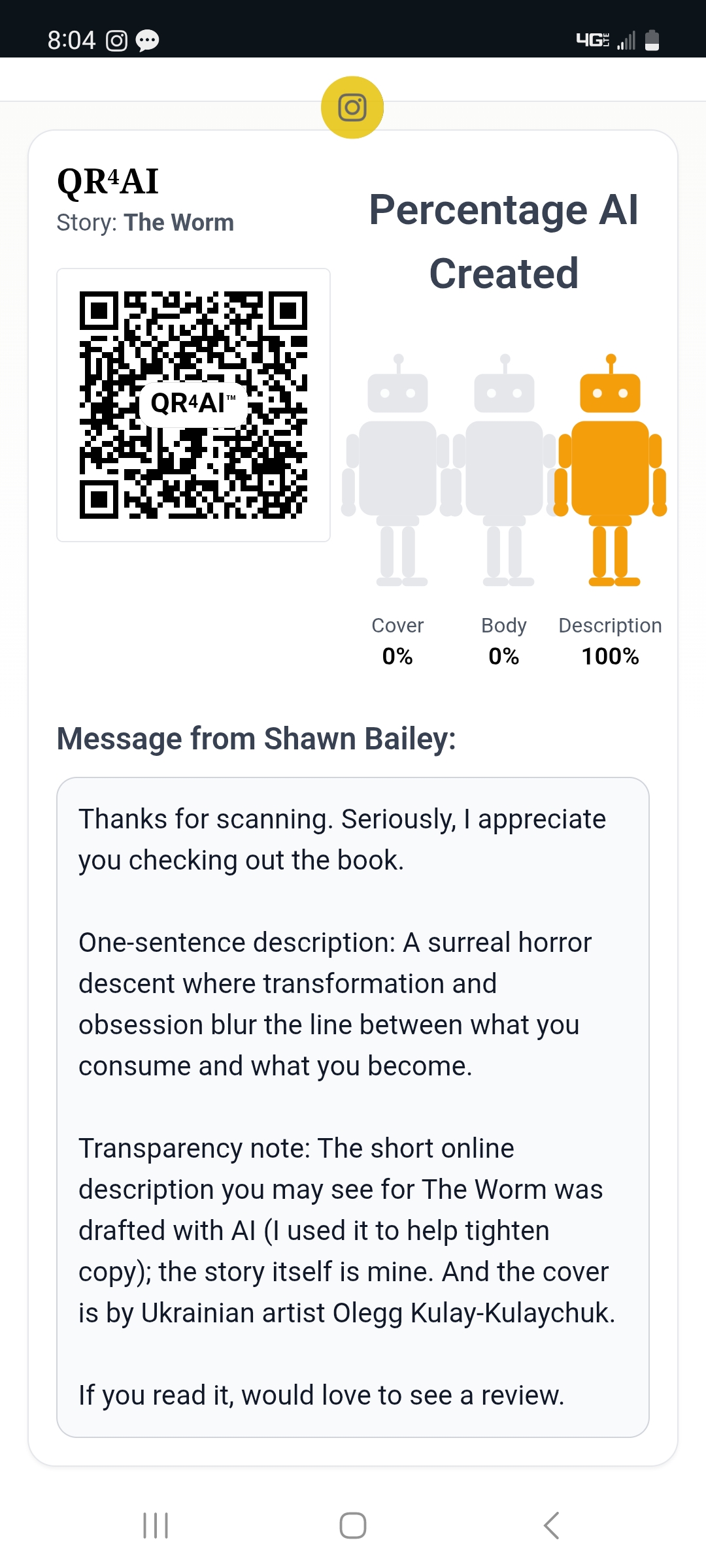
An AI transparency QR code you can place on your book cover or anywhere online. A reader can scan it (or click it online) and it links to a short note written by you, the author, about the creative process and any AI usage for that specific book. The author fills this out for each title—honor system.
Test example for mobile return
Do I have to upload my manuscript to use QR4AI?
No. You can create a QR that points to your note without uploading the manuscript. We still need a story title to tie it to, but not the body of the text.
Character Sheets
What are character sheets?
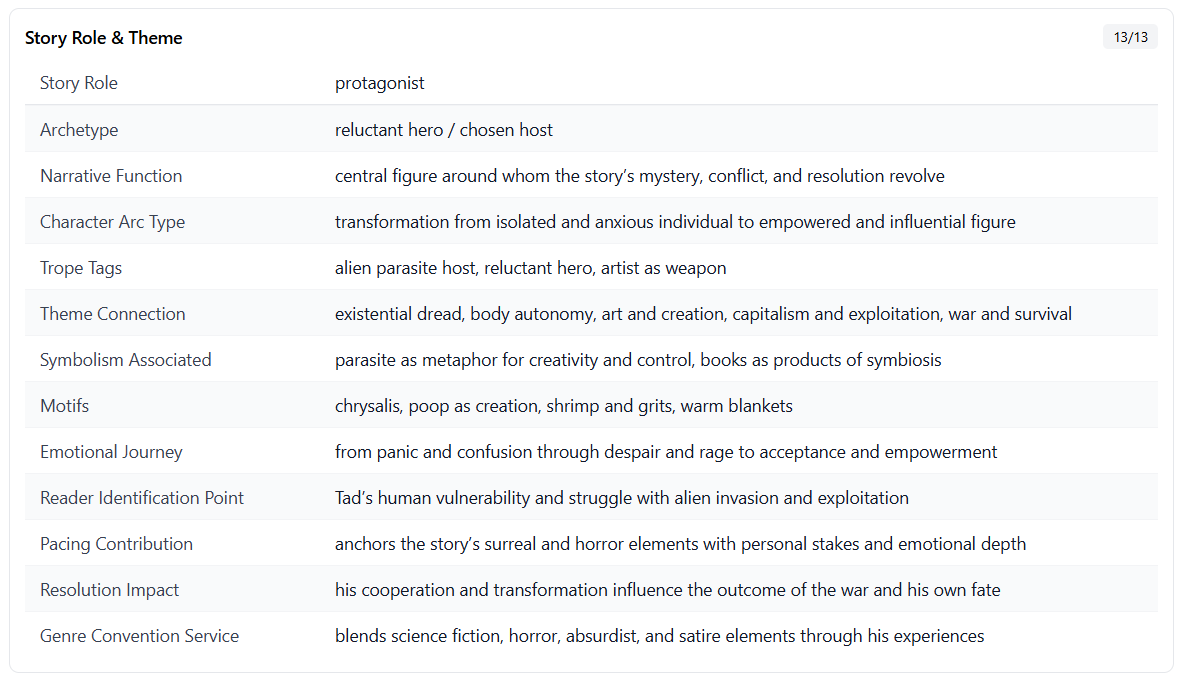
Character sheets are detailed profiles generated from your manuscript to help you understand (and revise) the characters that matter most. They’re designed for developmental work: clarity, consistency, and stronger choices.
Each sheet focuses on what the story actually shows: who the character is, what they want, what they fear, how they change, how they speak, how they behave under stress, and how they impact the plot and other characters.
The process is two steps: first, AI identifies and ranks the most important characters in your story. Then it generates a separate sheet for each of those characters so the profiles stay deep and specific.
Use these to spot gaps (unclear motivation, inconsistent behavior, missing arc), tighten relationships, and make sure your major characters feel distinct and intentional.
Example section from my novel The Worm
Why would I not pick 20 and get the most for my money?
For character sheets, I run AI to select the most important characters from your story and rank them in order of importance. Then I run calls for each separate character.
Compute uses energy and resources. The less compute, the less energy consumption. If you only have three characters you care about and choose twenty, you'll get mostly empty character sheets, including the guy who handed your protagonist change at the register or the lady walking her dog across the street. The purpose of the character sheets is to get a full picture of your important characters. Anything more is waste.
That being said, AI can sometimes not get things right. I spent a lot of time trying to not only get the most important characters from your story but to also rank and order them. This is way more difficult than it sounds. Think about aliases, doppelgängers, werewolves, clones, the list goes on. Is the werewolf the same character? Is a clone? So, the list might not always be in perfect order.
For this reason, I would count the important characters you want from your story and round up. Example: Your story has exactly 7 main characters and 4 supporting characters. You would round up to 15 to be safe, in case one of your NPCs gets ranked above your important characters and your list is cut short. I've really only left the twenty option there for longer fantasy novels.
Another concern is time. After one API call to get the most important characters, I use one API call per character to get the character sheets. I could do it all in one call but it's not as fleshed out. Twenty API calls on a thinking model can get expensive. It can also take more time. If there are others in the queue, you may have a longer wait.
Developmental Edits
What's included in a dev edit?
Big-picture feedback: Marketability, Overall Structure and Organization, Character Development, Plot Development, Thematic Consistency, World-building, Narrative Voice and Style, Dialogue and POV, Reader Engagement and Emotional Impact, Pacing and Momentum, Genre Specific Expectations, Genre Specific Elements, Summary, Revision plan
Important: Do your developmental edit before any heavy rewrites or line/copy edits, so you don’t polish scenes that may change. Please run a basic proofread before submitting so the structural feedback can stay focused on the story itself.
Do you use AI?
What file types can I upload?
Max length: 300,000 words.
File types: .txt and .docx only. Also on the roadmap: epub and pdf support.
Turnaround & pricing
Turnaround: Depends on how many other people are in line and the length of your story. Usually no more than 10 or 15 minutes.
Adding character sheets takes more time as well. And sometimes things just happen. You’ll get an email when it’s ready. You will be able to see your character sheets as they are created by refreshing the page, but the email will signify when everything is done.
Pricing: You can check pricing by visiting the Credits page.
Confidentiality
We all know you can't trust billionaires and AI companies. That being said, your work is treated as confidentially as I can treat it. The flag is set to not train the models and I would never sell your info or breech that trust on purpose. But know that AI will have its greasy hands all up in your words.
By using the service, you understand that your uploaded text is stored in a database (encrypted) to generate feedback and to give you access to more tools that are being implemented. You can delete the story at any time if you have concerns about your data.